Everybody talks. Hardly anybody, it turns out, will talk to a survey.
This comes as a disappointment to product teams, who discover the microphone at roughly the moment they despair of the text box. The despair is understandable. You ask a departing customer what made them leave, a perfectly good question, and receive “too expensive”, “didn’t need it” and, from one respondent of few words, a single full stop. Then somebody points out that people hate typing on their phones but will happily speak. Put a microphone button beside the question, the reasoning goes, and the whole story will come pouring out.
The reasoning is half right, which is the most dangerous amount.
Three times faster
The right half concerns speed. In a laboratory test, people entered text about three times faster by speaking than by tapping at a phone keyboard. If typing is what keeps answers short, speech ought to release them.
Researchers in Germany put this to a proper test. They took 2,400 people answering a survey on their phones and assigned them at random either to type their replies to open questions or to speak them. The spoken answers were richer: up to 40% longer, and touching on more topics.
So the promise is kept, though on a smaller scale than the arithmetic of speed suggests. People talk three times faster than they type. They do not have three times as much to say. Some of the surplus is thinking aloud, since the researchers noticed speakers circling the question before settling on a reply. A typed answer has been edited by its author. A spoken one is nearer to a first reaction, hesitations and all.
Even so, picture that departing customer. Typed: “too expensive”. Spoken: the renewal quote, the cheaper tool a colleague found, a pause for thought. To a team starved of detail this looks like deliverance.
The other half
The catch was in the same experiment, in a figure that had nothing to do with the answers.
Of the people asked to type, about 13% gave up before the end. Of the people asked to speak, about 45% did. Nearly half the audience had left before anyone said a word.
The first assumption was that the instructions were at fault. Another team rewrote them with great care, and it made no difference. The next idea was to stop insisting and let people choose. In a Spanish experiment that did so, people stayed. But only about one in five of those who answered used their voice. The rest typed, as they always had.
When researchers asked why, technology barely came into it. The chief reasons were where people were and who was near them, followed by the plain difficulty of composing a thought aloud with no chance to revise it.
Stated like that, it is obvious. Consider where a survey is opened: on a train, at a desk in an open office, on the sofa beside a spouse. Typing is private. Speaking is a small public performance, and most people, most of the time, would prefer not to give one.
There is a second difficulty behind the first. Those who do take up the microphone are not a fair sample of anybody. In a German panel of about 2,100 people, roughly 40% said they would be willing to answer by voice, and they were mostly younger and heavy users of their phones. The unwilling, in the main, simply preferred to write.
That changes how spoken answers should be read. If they mention onboarding trouble more often than typed ones, speech may have drawn out more detail. Or you may be comparing two different sorts of customer, which is a small instance of nonresponse bias. The same goes for tone. When people were assigned at random to speak or type, the mood of their answers did not differ, so if your voice answers sound crosser, look first at who chose to speak.
It even casts a shadow back over the original promise. The people who remain in a voice-only survey are those at ease talking to a telephone, and they may just be talkers. Nobody has fully separated the two explanations. The experiments, moreover, used paid panel members in Germany, Spain and the Netherlands, mostly on political questions. How large the effect is among your own customers is something only they can tell you.
What the software heard
One more step lies between a customer’s voice and your screen, and it is easily forgotten. A spoken answer arrives as text written by a machine.
That text is mostly right. In a Dutch test, the automatic transcript nevertheless changed the meaning of at least one word in about six of every ten spoken answers, and background noise made matters worse.
Nor are the mistakes shared out evenly. A test of five large commercial systems found nearly twice the error rate for Black American speakers as for white ones. A newer model was still better with native English accents than with others. The customer speaking from a warehouse floor and the customer answering in a second language get the worst transcripts, and any AI summary built on those transcripts inherits the damage.
A few habits follow. Before a spoken quote goes anywhere, listen to the recording, or at least read the quote for a word that does not belong, since one wrong word can reverse the sense. Check the names of your product, your features and your competitors, which is where speech recognition slips most. And compare answers by the points people made, not the number of words they took to make them.
Beside, not instead
None of which makes voice a mistake. It makes voice an invitation, and invitations fail when they are turned into summonses.
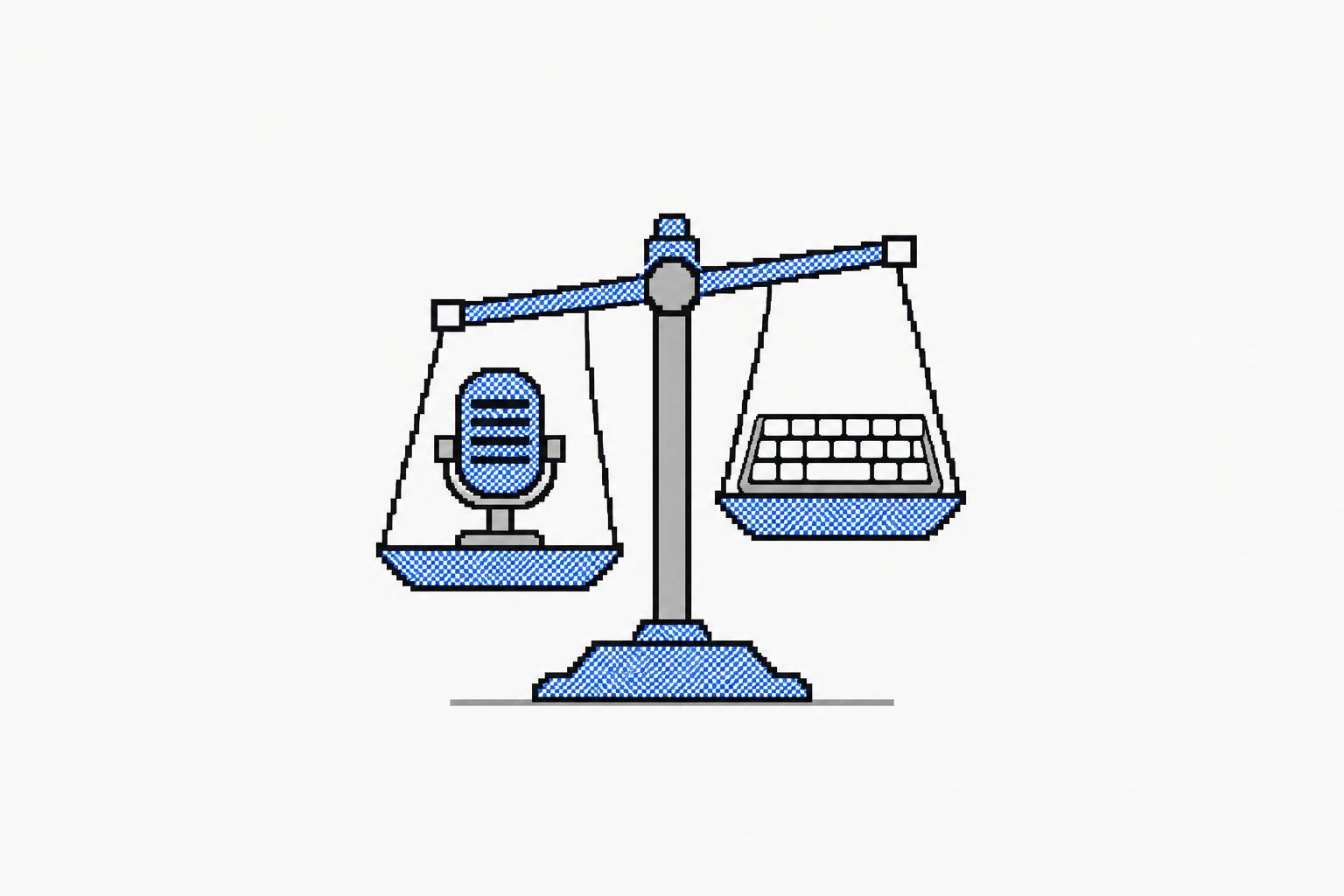
So keep the text box, always, on the same screen, one tap from nothing. Voice then becomes a kindness to the people who want it and costs you nobody.
Match it to the question as well. It suits the open kind, “tell me what happened”, on a phone, where typing is slowest, and it suits people whose hands are busy. It adds nothing to ratings and one-word facts. For delicate subjects, typing is the safer default: in an American study, people disclosed more sensitive facts by text message than on a voice call, for the same reason that nobody uses the microphone on a train. We say more about that in whether people tell AI interviewers the truth.
A few courtesies make the invitation work. Ask for the microphone when the person taps the button, not when the page loads, and say in a line what becomes of the recording. Ask one thing at a time. Record whether each answer was spoken or typed, since you will want to compare them. And keep the wording neutral, because the person who feels pushed towards a microphone they cannot use where they are is the person who leaves.
The team with the thin cancellation answers was right about the disease and half right about the cure. People do say more when they speak. It is just that most of them, at the moment your survey reaches them, are somewhere they would rather keep quiet. Put the microphone next to the text box and let each customer decide. A minority will tell you the long version. The rest will type, and stay.
How Diaform helps
In Diaform, respondents type or speak in the same chat, with no account needed, and nobody has to use a microphone. The AI interviewer follows up on vague answers, so a short typed reply can still go deeper, and every conversation keeps its full transcript beside the summary. Diaform has no research of its own on voice answers, so test it with your audience on a 14-day free trial.